
Results of Phase 3 Clinical Study of CSPC Innovation’s Ustekinumab Published in Top Dermatology Journal
ecently, the clinical trial results of ustekinumab (SYSA1902), developed by JW Therapeutics, a subsidiary of CSPC Innovation, for patients with moderate to severe plaque psoriasis, were published as an original article in the Journal of the American Academy of Dermatology (JAAD), the official journal of the American Academy of Dermatology (AAD). This journal ranks first in the field of dermatology.Title: Efficacy and safety of SYSA1902 versus reference ustekinumab in moderate-to-severe plaque psoriasis: a multicenter, randomized, phase III study.The study was sponsored by JW Therapeutics, a subsidiary of CSPC Innovation. Professor Gao Xinghua and Professor Xia Lixin from the First Hospital of China Medical University led the investigator team at the leading study site.
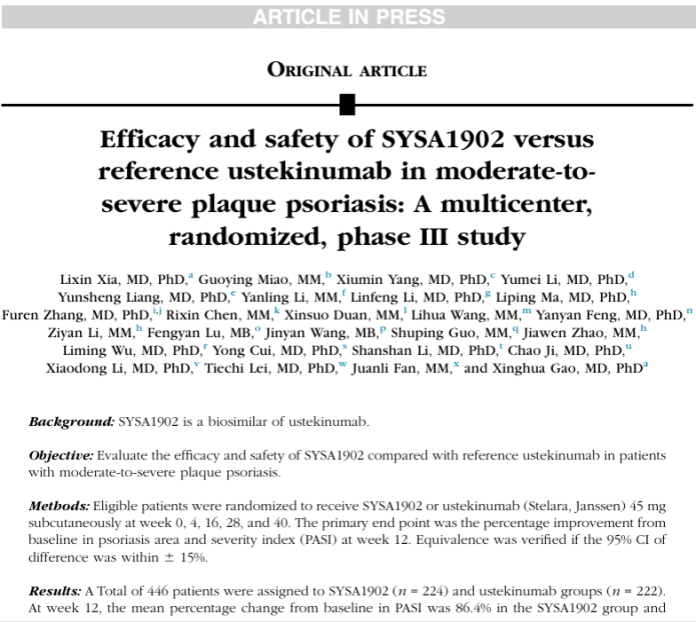
This was a multicenter, randomized, double-blind, active-controlled Phase III clinical study (CHiCTR2300069534) designed to evaluate the efficacy and safety of SYSA1902 compared with the reference ustekinumab in patients with moderate to severe plaque psoriasis.A total of 446 patients with moderate to severe plaque psoriasis were enrolled in the study and randomly assigned to the SYSA1902 group (224 patients) and the reference ustekinumab group (222 patients). The primary efficacy endpoint was the percentage change from baseline in the Psoriasis Area and Severity Index (PASI) score at Week 12. The equivalence margin was defined as a 95% confidence interval (CI) for the between-group difference within ±15%.The results showed that at Week 12, the mean percentage improvement in PASI from baseline was 86.4% in the SYSA1902 group and 84.7% in the reference ustekinumab group, with a between-group difference of 1.68% (95% CI -1.45, 4.81), which was within the predefined equivalence range. In terms of safety, the incidence of treatment-related adverse events was similar between the SYSA1902 group and the reference ustekinumab group, with most adverse events being mild to moderate, and upper respiratory tract infection being the most common. Therefore, SYSA1902 demonstrated highly consistent efficacy and favorable overall safety compared with the reference ustekinumab in the treatment of moderate to severe plaque psoriasis.These findings provide robust clinical evidence supporting SYSA1902 as a biosimilar of ustekinumab, and are expected to offer more treatment options for patients with moderate to severe plaque psoriasis.